The Gates of Hell Museum of Decorative Arts Paris

The Gates of Hell (French: La Porte de 50'Enfer) is a monumental statuary sculptural grouping work by French artist Auguste Rodin that depicts a scene from the Inferno, the first section of Dante Alighieri's Divine One-act. It stands at half dozen metres high, 4 metres broad and 1 metre deep (xix.7×13.ane×3.three ft) and contains 180 figures. The figures range from xv centimetres (6 in) high up to more one metre (three ft). Several of the figures were also cast as independent free-continuing statues.
History [edit]
The sculpture was commissioned by the Directorate of Fine Arts in 1880 and was meant to be delivered in 1885.[ citation needed ]
Rodin would go along to piece of work on and off on this project for 37 years, until his expiry in 1917.[ citation needed ]
The Advisers asked for an inviting entrance to a planned Decorative Arts Museum with the theme being left to Rodin's selection. Even earlier this commission, Rodin had developed sketches of some of Dante'southward characters based on his admiration of Dante's Inferno.[1]
The Decorative Arts Museum was never built. Rodin worked on this projection on the ground floor of the Hôtel Biron. Near the end of his life, Rodin donated sculptures, drawings and reproduction rights to the French government. In 1919, two years after his decease, the Hôtel Biron became the Musée Rodin, housing a cast of The Gates of Hell and related works.[ citation needed ]
Inspiration [edit]
Through me the mode into the suffering city,
Through me the way to the eternal hurting,
Through me the way that runs among the lost.
Justice urged on my high artificer;
My Maker was Divine say-so,
The highest Wisdom, and the primal Dearest.
Earlier me nothing merely eternal things
Were made, and I endure eternally.
Carelessness every hope, who enter here.
Dante, Inferno, three.1–9
Rodin conceived that people would walk toward the work, peradventure up a flight of stairs, and be overwhelmed frontally past the massive gates, contemplating the experience of hell that Dante describes in his Inferno. Rodin idea particularly of Dante's warning over the entrance of the Inferno, "Carelessness every hope, who enter here."[2]
A work of the scope of The Gates of Hell had not been attempted earlier, just inspiration came from Lorenzo Ghiberti'south Gates of Paradise at the Baptistery of St. John, Florence, 15th century statuary doors depicting figures from the Onetime Testament. Another source of inspiration was medieval cathedrals combining high and low relief. Rodin was also inspired by Michelangelo'south fresco The Concluding Judgment, Delacroix's painting The Barque of Dante, Balzac'south collection La Comédie humaine and Baudelaire'southward poems Les Fleurs du mal.[3] [4]
In an commodity in Le Matin, Rodin said: "For a whole year I lived with Dante, with him alone, drawing the viii circles of his inferno. [...] At the end of this year, I realized that while my cartoon rendered my vision of Dante, they had become too remote from reality. Then I started all over again, working from nature, with my models."[5]
Gallery [edit]
- Variations of The Gates of Hell
-
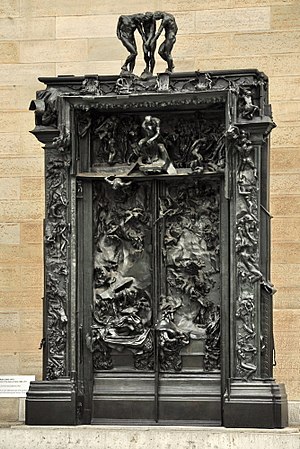
The Kunsthaus Zürich in Zurich
-

-

-
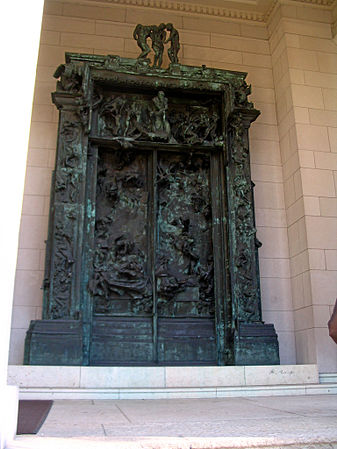
-

Outstanding figures [edit]

The Thinker in the Gates at the Musée Rodin

Detail of the Kneeling Female person Faun in the tympanum
The original sculptures were enlarged and became works of art of their own.
- The Thinker (Le Penseur), likewise called The Poet, is located above the door panels. Ane interpretation suggests that information technology might represent Dante looking downward to the characters in the Inferno. Another interpretation is that the Thinker is Rodin himself meditating almost his composition. Others believe that the figure may be Adam, contemplating the devastation brought upon mankind because of his sin.
- The Kiss (Le Baiser) was originally in The Gate along with other figures of Paolo and Francesca da Rimini. Rodin wanted to correspond their initial joy also every bit their final damnation. He removed the effigy that became known as The Kiss because it seemed to disharmonize with the other suffering figures.
- Ugolino and His Children (Ugolin et ses enfants) depicts Ugolino della Gherardesca, who according to the story, ate the corpses of his children after they died by starvation (Dante, Inferno, Canto XXXIII). The Ugolino grouping was cast as a separate bronze in 1882.
- The 3 Shades (Les Trois Ombres) was originally 98 cm high. The over-life size group was initially made of three independent figures in 1899. Afterward on, Rodin replaced 1 hand in the figures to fuse them together, in the aforementioned form every bit the smaller version. The figures originally pointed to the phrase "Lasciate ogne speranza, voi ch'intrate" ("Abandon all hope, ye who enter hither") from Canto 3 of the Inferno.[half-dozen]
- Fleeting Dear (Fugit Amor) is located on the right door pane, information technology is one of several figures of lovers that represent Paolo and Francesca da Rimini. The male figure is too called The Prodigal.
- Paolo and Francesca is shown on the left door pane. Paolo tries to reach Francesca, who seems to slip away.
- Meditation appears on the rightmost office of the tympanum, shown as an enlarged figure in 1896.
- The Old Courtesan is a bronze cast from 1910 of an aged, naked female body. The sculpture is as well called She Who Was Once the Helmet-Maker'southward Beautiful Married woman (Celle qui fut la belle heaulmière). This title is taken from a poem past François Villon.
- Fallen Brace Carrying Her Stone is based on the figure at the top of the left pilaster. Around 1881 Rodin enlarged her and gave her a stone.[seven]
- I Am Beautiful (Je suis belle), bandage in 1882, is amongst the second set of figures on the extreme correct portion of the door.
- Eternal Springtime (L'Éternel printemps) was cast in 1884. It exists in several separate versions, both in marble and in bronze.
- Despair is plant in various versions on both the left and right door panes.
- Kneeling Female Faun was conceived around 1884 and outset cast in 1887. It is found on the left side of the tympanum, in front of the bas-reliefs which form the background.
- Adam and Eve. Rodin asked the directorate for additional funds for the independent sculptures of Adam and Eve that were meant to frame The Gates of Hell. Notwithstanding, Rodin found he could not go Eve'due south figure right. Consequently, several figures of Eve were made, none of which were used, and all of them were later sold.
Most of the individual figures portrayed on the gates exercise not originate in Dante. Rodin's sculptures are not illustrations of scenes from Inferno. Rather, Rodin "reinvented" Dante'southward hell to include figures who personified his ain conception. Dante's Adam and Eve, for example, are in Paradise, thought to have been "rescued" from eternal damnation by Christ on Holy Saturday in the Harrowing of Hell.[ citation needed ]
The 3 shades are a transformation of three sinners whom Dante encounters in the Seventh Circle of murderers, suicides and homosexuals, all included among the violent confronting others, self and nature.[ citation needed ]
Other figures are either fully invented by Rodin or derive from other literary sources.[ commendation needed ]
Locations [edit]
| External video | |
|---|---|
 | |
 Rodin'southward The Gates of Hell, Smarthistory[8] Rodin'southward The Gates of Hell, Smarthistory[8] | |
| The Gates of Hell, The story of a damned artwork , Canal Educatif[9] |
The original plaster was restored in 1917 and is displayed at the Musée d'Orsay in Paris.[8] A series of plaster casts illustrating the evolution of the work is on view at the Musée Rodin in Meudon. Likewise in 1917, a model was used to brand the original three bronze casts:
- The Musée Rodin, Paris.[10]
- The Rodin Museum, Philadelphia, Pennsylvania.
- The National Museum of Western Art in Ueno Park, Tokyo.[11]
Subsequent bronzes have been distributed by the Musée Rodin to a number of locations, including:
- The Kunsthaus Zürich, Zurich
- The Iris & B. Gerald Cantor Eye for Visual Arts at Stanford University
- The Plateau, Seoul, Korea
- Museo Soumaya, Mexico City
See also [edit]
- Dante and his Divine Comedy in popular culture
- Well to Hell hoax
References [edit]
- ^ Elsen, Albert E. (1963). Rodin . New York: Museum of Mod Art. p. 35.
- ^ Fisher, Paul Zelanski, Mary Pat (2011). The Fine art of Seeing (8th ed.). Upper Saddle River, NJ: Prentice Hall. pp. 73–4. ISBN978-0-205-74834-1.
- ^ Musée Rodin, La Porte de fifty'Enfer (French)
- ^ Musée Rodin
- ^ Basset, Serge (nineteen March 1900). "LA PORTE DE 50'ENFER". Le Matin. Paris. Retrieved 25 Oct 2018.
- ^ Le Normand-Romain, Antoinette (1999). Rodin:The Gates of Hell. Paris: Musée Rodin. ISBN2-901428-69-X.
- ^ Fallen Brace Carrying Her Stone at the Met
- ^ a b "Rodin'southward The Gates of Hell". Smarthistory at Khan Academy. Retrieved xiii March 2013.
- ^ "The Gates of Hell, The story of a damned artwork". Canal Educatif. Retrieved thirteen March 2013.
- ^ "The Gates of Hell". Musée Rodin. Retrieved 27 January 2012.
- ^ "The Gates of Hell". The National Museum of Western Fine art. Retrieved 27 Jan 2012.
Farther reading [edit]
- Chevillot, Catherine; Marraud, Hélène; Pinet, Hélène; Adamson, John (transl.) (November 2014). Rodin: The Laboratory of Creation. Dijon: Éditions Faton. ISBN9782878442007.
- Le Normand-Romain, Antoinette (September 2014). Rodin. New York: Abbeville. ISBN9780789212078.
External links [edit]
- La Porte de 50'Enfer, a tool for exploring The Gates of Hell by the Musée Rodin
- Rodin: The B. Gerald Cantor Drove, a full text exhibition catalog from The Metropolitan Museum of Art, which contains material on The Gates of Hell
- Octave Mirbeau, « Auguste Rodin ».
- The Gates of Hell, Iris & B. Gerald Cantor Center for Visual Arts at Stanford Academy, Object Number 1985.86, bronze cast No. 5.
Source: https://en.wikipedia.org/wiki/The_Gates_of_Hell
0 Response to "The Gates of Hell Museum of Decorative Arts Paris"
Post a Comment