Art From Aztecs What Art Did the Aztecs Do
The Aztec civilization, centred at the upper-case letter of Tenochtitlan, dominated virtually of Mesoamerica in the 15th-16th centuries. With armed forces conquest and trade expansion, the art of the Aztecs likewise spread, helping the Aztec civilization reach a cultural and political hegemony over their subjects and creating for posterity a tangible record of the creative imagination and bang-up talent of the artists from this last great Mesoamerican civilization.
Influences
Common threads run through the history of Mesoamerican culture and peculiarly in art. The Olmec, Maya, Toltec, and Zapotec civilizations, amongst others, perpetuated an creative tradition which displayed a love of awe-inspiring stone sculpture, imposing architecture, highly decorated pottery, geometric stamps for fabric and torso fine art, and breathtaking metalwork which were all used to stand for people, animals, plants, gods and features of religious ceremony, especially those rites and deities connected to fertility and agriculture.
Aztec artists were also influenced by their contemporaries from neighbouring states, peculiarly artists from Oaxaca (a number of whom permanently resided at Tenochtitlan) and the Huastec region of the Gulf Coast where there was a strong tradition of iii-dimensional sculpture. These diverse influences and the Aztecs' ain eclectic tastes and admiration of ancient art made their fine art one of the most varied of all ancient cultures anywhere. Sculptures of gruesome gods with abstract imagery could come from the aforementioned workshop equally naturalistic works which depicted the beauty and grace of the animal and human form.
Features of Aztec Art
Metalwork was a particular skill of the Aztecs. The great Renaissance artist Albrecht Drurer saw some of the artefacts brought dorsum to Europe which caused him to say, '...I have never seen in all my days that which so rejoiced my heart, as these things. For I saw among them amazing creative objects, and I marvelled over the subtle ingenuity of the men in these distant lands'. Unfortunately, as with most other artefacts, these objects were melted downwardly for currency, and and then very few examples survive of the Aztecs' fine metalworking skills in gold and silver. Smaller items have been discovered, amongst them gold labrets (lip piercings), pendants, rings, earrings and necklaces in gold representing everything from eagles to tortoise shells to gods, which are testimony to the skills in lost-wax casting and filigree piece of work of the finest artisans or tolteca.
The Aztecs also employed art equally a tool to reinforce their military & cultural authority across Mesoamerica.
Aztec sculpture has been a improve survivor, and its subject was very often individuals from the extensive family of gods they worshipped. Carved in stone and wood these figures, sometimes monumental in size, were not idols containing the spirit of the god, as in Aztec religion the spirit of a particular deity was thought to reside in sacred bundles kept inside shrines and temples. Yet, it was thought necessary to 'feed' these sculptures with blood and precious objects, hence tales from the Spanish conquistadors of huge statues splattered with blood and encrusted with jewels and gold. Other large sculptures, more than in the round, include the magnificent seated god Xochipilli and the various chacmools, reclining figures with a hollow carved in the breast which was used as a receptacle for the hearts of sacrificial victims. These, as with most other Aztec sculpture, would have one time been painted using a wide range of brilliant colours.
Smaller-scale sculpture has been institute at sites beyond Key United mexican states. These often take the course of local deities and peculiarly gods related to agriculture. The about mutual are upright female figures of a maize deity, typically with an impressive headdress, and the maize god Xipe Totec. Lacking the finesse of majestic-sponsored fine art, these sculptures and like pottery figures often correspond the more than benevolent side of the Aztec gods.
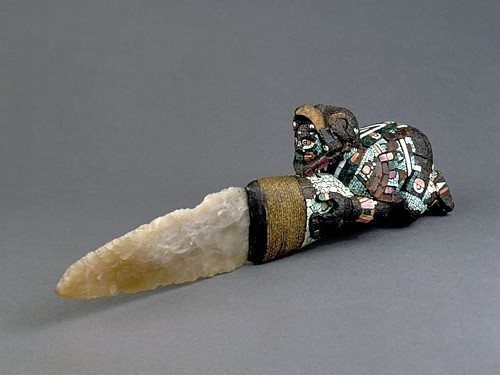
Aztec Formalism Knife
Miniature piece of work was as well popular where subjects such as plants, insects, and shells were rendered in precious materials such as carnelite, pearl, amethyst, rock crystal, obsidian, shell, and the virtually highly valued of all materials, the jewel jade. 1 other material which was highly prized was exotic feathers, especially the green plume of the quetzal bird. Feathers cutting up into minor pieces were used to create mosaic paintings, every bit decoration for the shields of Aztec warriors, costumes and fans, and in magnificent headdresses such every bit the 1 ascribed to Motecuhzoma Two which is now in the Museum für Völkerkunde in Vienna.
Turquoise was a particularly favoured cloth with Aztec artists, and the use of it in mosaic course to cover sculpture and masks has created some of the well-nigh striking imagery from Mesoamerica. A typical example is the decorated human skull which represents the god Tezcatlipoca and which at present resides in the British Museum, London. Another fine example is the mask of Xiuhtecuhtli, the god of burn, with sleepy-looking mother-of-pearl eyes and a perfect set of white conch shell teeth. Finally, there is the magnificent double-headed ophidian pectoral, as well now in the British Museum. With carved cedar forest completely covered in small squares of turquoise and the ruby-red mouths and white teeth rendered in spondylus and conch vanquish respectively, the piece was probably once office of a formalism costume. The snake was a strong paradigm in Aztec art every bit the creature, able to shed its skin, represented regeneration and was also particularly associated with the god Quetzalcoatl.
Despite the absence of the potter's wheel, the Aztecs were also skilled with ceramics every bit indicated by big hollow figures and several beautifully carved lidded-urns which were excavated by the side of the Templo Mayor at Tenochtitlan, probably used equally receptacles for funeral ashes. Other examples of ceramic works are the moulded censers with tripod legs from Texcoco, spouted jugs, and elegant hourglass-shaped cups. These vessels are typically thin-walled, well proportioned, have a cream or red and black sideslip, and carry finely painted geometric designs in earlier designs and flora and fauna in subsequently examples. The most highly-prized ceramics by the Aztecs themselves, and the type which Motecuhzoma himself used, were the ultra-thin Cholula ware from Cholollan in the Valley of Puebla. Vessels could also exist made from moulds or carved while the clay was still leather-hard. A fine example of these anthropomorphic vessels is the historic vase representing the head of the rain god Tlaloc painted a vivid bluish, with goggle eyes and fearsome red fangs, now in the National Museum of Anthropology in Mexico City.
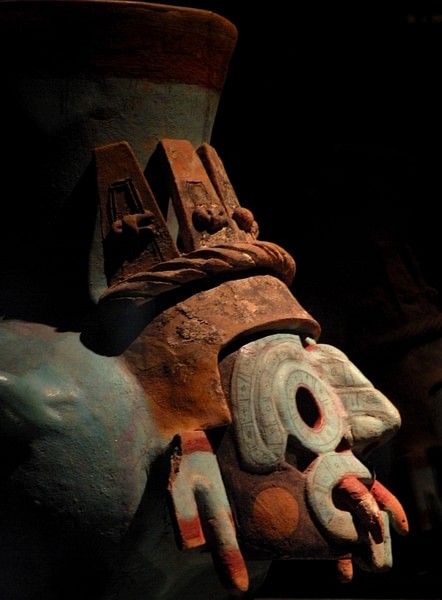
Tlaloc
Musical instruments were some other important office of the Aztec creative person'south repertoire. These included ceramic flutes and wooden teponaztlis and huehuetls, respectively, long and upright formalism drums. They are richly busy with carvings, and i of the finest is the Malinalco drum which is covered in dancing jaguars and eagles who represent sacrificial victims as indicated by banners and speech scrolls of warfare and fire symbols.
Art as Propaganda
The Aztecs, as with their cultural predecessors, employed art equally a tool to reinforce their military machine and cultural authorization. Imposing buildings, frescoes, sculpture and even manuscripts, especially at such key sites equally Tenochtitlan, not only represented and even replicated the key elements of Aztec religion, but they also reminded subject peoples of the wealth and ability which permitted their construction and manufacture.
The supreme case of this utilise of art as a conveyor of political and religious messages is the Templo Mayor at Tenochtitlan which was much more than than a hugely impressive pyramid. Information technology was carefully designed in every detail to stand for the sacred snake mount of the earth Coatepec, so important in Aztec organized religion and mythology. This mountain was the site where Coatlicue (the earth) gave nascence to her son Huitzilopochtli (the sun), who defeated the other gods (the stars) led past his sis Coyolxauhqui (the moon). A temple to Huitzilopochtli was congenital on top of the pyramid along with another in accolade of the rain god Tlaloc. Further associations with the myth are the snake sculptures lining the base of operations and the Bang-up Coyolxauhqui Stone carved in c. 1473, likewise found at the base of the pyramid and which represents in relief the dismembered body of the fallen goddess. The stone, forth with other such sculptures every bit the Tizoc Stone, related this cosmic imagery to the contemporary defeat of local enemies. In the case of the Coyolxauhqui Stone, the defeat of the Tlatelolca is being referenced. Finally, the Templo Mayor was itself a repository of fine art as, when its interior was explored, a vast hoard of sculpture and art objects were discovered entombed with the remains of the dead and these pieces are, in many cases, works that the Aztecs had themselves nerveless from more than aboriginal cultures than their own.
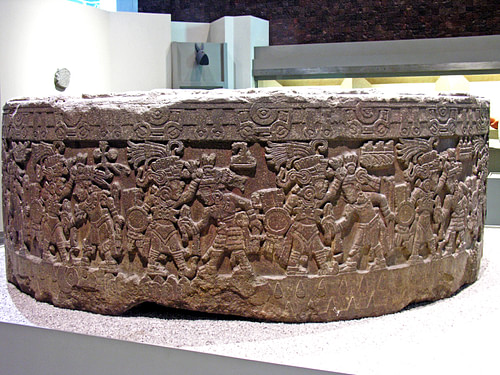
Tizoc Stone
Temples extolling the Aztec view of the world were also constructed in conquered territories. The Aztecs usually left existing political and administrative structures in place, but they did impose their own gods in a hierarchy above local deities, and this was largely done through architecture and art, backed upwards with sacrificial ceremonies at these new sacred places, typically constructed on previous sacred sites and often in spectacular settings such as on mountain peaks.
The Sun Stone was carved c. 1427 & shows a solar disk which presents the five sequent worlds of the dominicus from Aztec mythology.
Aztec imagery which spread beyond the empire includes many lesser-known deities than Huitzilopochtli and in that location are a surprising number of examples of nature and agricultural gods. Mayhap the most famous are the reliefs of the water goddess Chalchiuhtlicue on the Malinche Hill virtually ancient Tula. These and other works of Aztec fine art were most ofttimes made by local artists and may have been deputed by regime representing the land or by individual colonists from the Aztec heartland. Architectural art, stone carvings of gods, animals and shields, and other art objects have been found beyond the empire from Puebla to Veracruz and especially effectually cities, hills, springs, and caves. Further, these works are normally unique, suggesting the absenteeism of any organised workshops.
Masterpieces
The large circular Rock of Tizoc (carved c. 1485 from basalt) is a masterful mix of cosmic mythology and real-world politics. It was originally used as a surface on which to perform human being cede and equally these victims were normally defeated warriors information technology is entirely appropriate that the reliefs effectually the edge of the rock draw the Aztec ruler Tizoc attacking warriors from the Matlatzinca, an area conquered by Tizoc in the late 15th century CE. The defeated are besides portrayed as Chichimecs i.due east. landless barbarians, whilst the victors wear the noble clothes of the revered ancient Toltec. The upper surface of the stone, ii.67 yard in diameter, depicts an eight-pointed sunday-deejay. The Stone of Tizoc now resides in the National Museum of Anthropology in Mexico City.
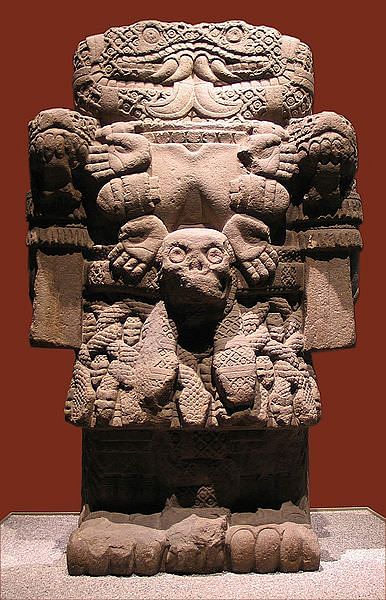
Coatlicue
The massive basalt statue of Coatlicue (carved in the final half-century of Aztec dominion) is widely considered one of the finest examples of Aztec sculpture. The goddess is presented in terrifying form with two snakeheads, clawed anxiety and hands, a necklace of dismembered easily and human hearts with a skull pendant, and wearing a skirt of writhing snakes. Mayhap ane of a group of four and representing the revelation of female power and terror, the 3.5 m high statue leans slightly forward and then that the overall dramatic effect of the slice is and then emotive that information technology is understandable why the statue was actually re-buried several times following its original excavation in 1790. The statue of Coatlicue now resides in the National Museum of Anthropology in Mexico Urban center.
The Sun Stone, also known as the Aztec Calendar Stone (despite the fact that it is not a functioning calendar), must be the about recognisable art object produced by whatever of the not bad civilizations of Mesoamerica. Discovered in the 18th century near the cathedral of Mexico Metropolis, the stone was carved c. 1427 and shows a solar disk which presents the five consecutive worlds of the sun from Aztec mythology. The basalt stone is three.78 m in diameter, well-nigh a metre thick and was once part of the Templo Mayor complex of Tenochtitlan. At the heart of the stone is a representation of either the sun god Tonatiuh (the Twenty-four hour period Sunday) or Yohualtonatiuh (the Nighttime Lord's day) or the primordial globe monster Tlaltecuhtli, in the latter instance representing the final destruction of the globe when the 5th dominicus brutal to earth. Around the central face at 4 points are the other four suns which successively replaced each other after the gods Quetzalcoatl and Tezcatlipoca struggled for control of the cosmos until the era of the 5th sun was reached. On either side of the central face are ii jaguar heads or paws, each clutching a heart, representing the terrestrial realm. The two heads at the bottom centre correspond burn down serpents, and their bodies run around the perimeter of the stone with each catastrophe in a tail. The four cardinal and the inter-fundamental directions are too indicated with larger and lesser points respectively.
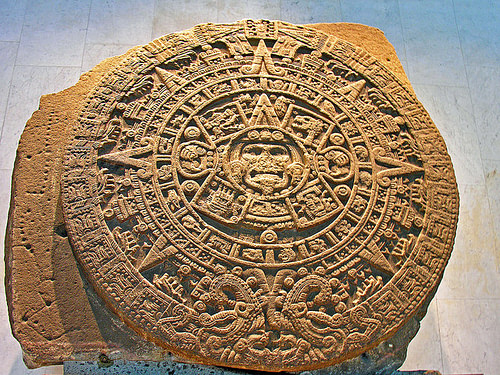
Aztec Sun Stone
Every bit 1 final example of the wealth of Aztec art which has survived the best destructive efforts of their conquerors, there is the life-sized hawkeye warrior from Tenochtitlan. The figure, seemingly most to accept flight, is in terra cotta and was fabricated in four divide pieces. This Eagle Knight wears a helmet representing the bird of prey, has wings and even clawed feet. Remains of stucco advise that the effigy was once covered in real feathers for an even more than life-similar effect. Originally, it would accept stood with a partner, either side of a doorway.
Conclusion
Following the autumn of the Aztec Empire the production of indigenous fine art went into decline. Withal, some designs of the Aztec civilization lived on in the work of local artists employed by Augustinian friars to decorate their new churches during the 16th century. Manuscripts and plumage paintings also continued to be produced, just it was not until the late 18th century that an involvement in Precolumbian art and history would lead to a more than systematic investigation of just what lay under the foundations of modern Mexican cities. Slowly, an ever-growing number of Aztec artefacts accept revealed, in instance there had ever been any doubt, proof-positive evidence that the Aztecs were amidst the nigh ambitious, artistic, and eclectic artists that Mesoamerica had always produced.
This article has been reviewed for accuracy, reliability and adherence to academic standards prior to publication.
0 Response to "Art From Aztecs What Art Did the Aztecs Do"
Post a Comment